KS Learning can provide extra lessons for maths from gcse maths tutors in London and help with gcse maths past papers, gcse maths revision notes, and gcse maths revision worksheets. Maths private tuition at its tuition centre can improve maths knowledge and performance through maths lessons, mathematics tutorials and maths tuition Twickenham.
| Question | Answer |
|---|---|
| How does the conservation of energy apply to a chemical reaction? | the total energy before and after the reaction must be the same as energy cannot be created or destroyed in the reaction |
| Why is energy transferred in a chemical reaction? | because chemicl bonds are made which releases energy and chemical bonds are broken which requires energy |
| What is an exothermic reaction? | energy is transferred from the reacting chemicals to the surroundings |
| What is an endothermic reaction? | energy is transferred from the surroundings to the reacting chemicals |
| How would a test tube containing an exothermic reaction feel in your hand? | the test tube would feel warm, sometimes even hot |
| How would a test tube containing an endothermic reaction feel in your hand? | the test tube would feel cold, sometimes very cold |
| What does the term combustion mean? | burning in oxygen gas |
| Is the combustion of fuels exo- or endothermic? | when fuels are burned in oxygen, they give off energy so the reaction is exothermic |
| Name two reactions that are exothermic. |
• the combustion of fuels • neutralisation reactions |
| What happens when methane gas burns? | it is oxidised and gives off energy |
| Write the equation for the combustion of methane? | CH4(g) + 2 O2(g) → CO2(g) + 2 H2O(l) |
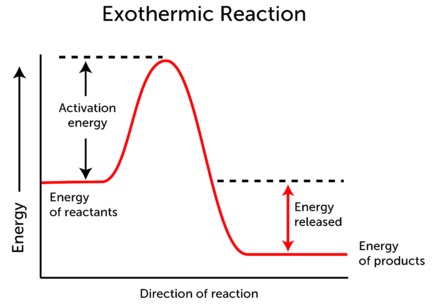
| Compare the energy content of the products and reactants of an exothermic reaction. | the products have a lower energy content than the reactants |
| Why does an exothermic reaction give off energy? | the products have a lower energy content than the reactants with the difference being given off as energy |
| The reaction of citric acid and sodium hydrogencarbonate is endothermic. What will happen to the temperature of this reaction as it progresses? | it will fall |
| Name a group of reacations that is endothermic. | thermal decomposition reactions |
| Write the equation for the thermal decomposition of calcium carbonate. | CaCO3(s) → CaO(s) + CO2(g) |
| Write the equation for the combustion of methane? | CH4(g) + 2 O2(g) → 2 H2O(l) + CO2(g) |
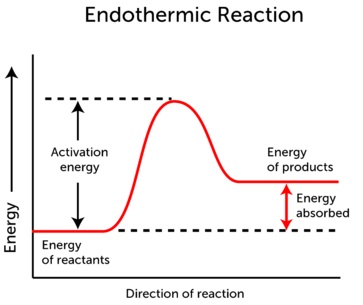
| Compare the energy content of the products and reactants of an endothermic reaction. | the products have a higher energy content than the reactants |
| Why does an endothermic reaction get cold? | the products have a higherer energy content than the reactants so must take energy from the surroundings making them cold |
| What is a reaction called that transfers energy to the surroundings? | exothermic |
| The temperature of a reaction changes from 27 °C to 19 °C as it progresses. What type of reaction is it? | the temperature is falling so endothermic |
| Question | Answer |
|---|---|
| What type of reaction is used in chemical hand and body warmers? | exothermic |
| When are hand and body warmers used? |
• for the relief of aches and pains • to keep warm at outdoor events on cold days |
| How often can hand warmers be used? | some can be used once, and some can be used again and again |
| Describe the workings of a hand warmer that can only be used once. |
• one type uses the oxidation of iron • iron turns into hydrated iron (III) oxide • sodium is used as a catalyst • the exothermic reaction lasts for many hours • the hand warmer is disposable as it can only be used once |
| What reactions are reusable hand warmers built on? | they are based on the formation of crystals from solutions of a salt |
| Describe the operation of a reusable hand warmer. |
• CH3COO-Na+ sodium ethanoate is often the salt used • a supersaturated solution of the salt is made by disolving the salt in hot water • the solution is then allowed to cool • the pack contains a small metal disc which must be pressed to start the warmer • when the metal disc is pressed, small amounts of metal are scraped off • the small pieces of metal start the crystalisation which is an exothermic reaction • the reaction lasts for about 30 minutes • placing the warmer in hot water will disolve the crystals and make it ready for re-use once cool |
| Name another use of exothermic reactions other than hand and body warmers. | self-heating cans to make drinks like hot coffe without an external heating device like a kettle |
| State the reaction usually used in self-heating food and drink packs | calcium oxide + water → calcium hydroxide |
| How is the heating activated in a self-heating can? |
• the water and calcium hydroxide are stored in separate compartments • a button on the bottom of the can breaks the seal between the two • the water and calcium hydroxide mix • the exothermic reaction happens transferring heat to the drink |
| How are endothermic reactions useful? | they can be used to cool things down |
| What chemicals do chemical cold packs usually contain? | ammonium nitrate and water |
| What happens when ammonium nitrate dissolves in water? | it absorbs energy from the surroundings making the surroundings colder |
| Where are cold packs useful? | they are useful as emergency treatments for sports injuries so often found in first aid kits for venues of sporting events |
| How do cold packs help with sports injuries? | the decrease in temperature reduces swelling and numbs pain |
| How does an instant cold pack work? |
• the ammonium nitrate and water are kept separate in the pack • squeezing the bag inside the water breaks releasing the ammonium nitrate • the instant cold pack works for around 20 minutes • instant cold packs can only be used once |
| Where else can the endothermic reaction of nitrate and water be used? | in drinks to cool them |
| Question | Answer |
|---|---|
| What is a reaction profile? | a diagram that shows the relative amounts of energy contained in the reatants and the products measured in kilojoules per mole (kJ/mol) |
What does the line on a reaction profile show?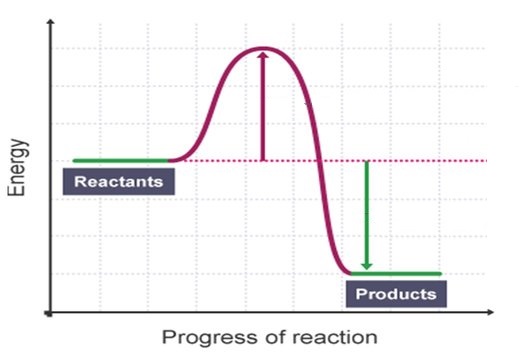
|
it shows the course of the reaction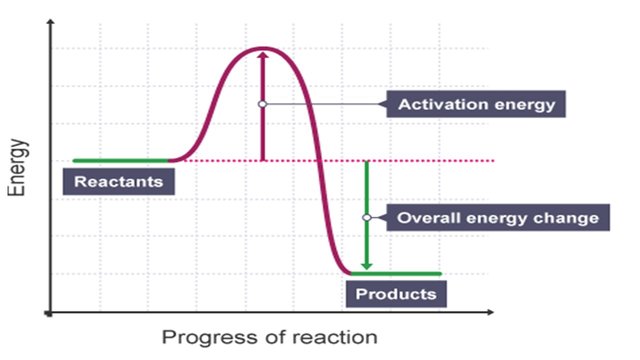
|
| What does the difference in energy between the reactants and the peak of the curve indicate? | the energy required to make the reaction happen |
| What does the difference in energy between the reactants and the products of the curve indicate? | the energy released to or taken in from the surroundings |
| What is the difference in energy between the reactants and the peak of the curve called? | the activation energy |
| What are the units for the difference in energy between the reactants and the products on the curve? | kJ/mol |
| What is a reaction called where the reactants are at a higher energy than the products? | an exothermic reaction |
| What is a reaction called where the reactants are at a lower energy than the products? | an endothermic reaction |
| What is an exothermic reaction? | a reaction that releases energy to the surroundings |
| What is an endothermic reaction? | a reaction that takes energy from the surroundings |
| What would you feel if you were holding a beaker with an exothermic reaction taking place in it? | your hand would get hotter |
| What would you feel if you were holding a beaker with an endothermic reaction taking place in it? | your hand would get colder |
| What is the effect of an exothermic reaction on the surroundings? | the surroundings get hotter and its temperature rises |
| Sketch the reaction profile for an exothermic reaction. |
|
| Sketch the reaction profile for an endothermic reaction. |
|
| What is the energy required to start a reaction called? | the activation energy |
| What is the activation energy? | the minimum amount of energy before colliding particles have sufficient energy to react |
| What will happen to colliding particles if they have less than activation energy? | they simply bounce off each other |
| What happens to the bonds when a reaction takes place? |
• first the chemical bonds between the atoms or ions in the reactants are broken • then new chemical bonds are formed to make the products |
| What is supplied to break bonds? | energy has to be supplied |
| What type of process is breaking bonds? | an endothermic reaction |
| What happens when bonds are made? | energy is transferred to the surroundings |
| What type of process is making bonds? | an exothermic reaction |
| How can bond breaking and making to determine the type of reaction? | by comparing the energy required to break and make the bonds in a reaction, it is possible to determine whether a reaction is exothermic and endothermic |
| Question | Answer |
|---|---|
| What happens to energy when new bonds are formed? | energy is released |
| What happens to energy when existing bonds are broken? | energy is absorbed |
| What determines whether a reaction is exothermic or endothermic? | the difference in energy between making and breaking bonds |
| Describe bond energy changes in an exothermic reaction. | the energy needed to break the bonds in the reactants is less than the energy released when forming new bonds in the products |
| Describe bond energy changes in an endothermic reaction. | the energy needed to break the bonds in the reactants is greater than the energy released when forming new bonds in the products |
| What is bond energy? | the energy needed to break the bond betweeen two atoms is called the bond energy |
| What are the units for bond energies? | kJ/mol |
| How do you calculate the energy change for a chemical reaction using bond energies? |
•calculate the energy needed to break the bonds in reactants •calculate the energy released to form the bonds in products •take the difference |
| Is the energy for breaking a specific bond different to forming the same bond? | no, the energy for breaking and forming a bond is the same |
| The bond energy to break a C-C bond is 347 kJ/mol. What is the energy released when forming a C-C bond? | 347 kJ/mol |
| Question | Answer |
|---|---|
| What chemical concept drives electrical cells and batteries? | the differing reactivity of metals |
| What determines displacement in a chemical reaction? | the reactivity of the metals involved |
| What ions do metals form? | they tend to lose electrons and form positive ions |
| Complete the following reaction: Zn(s) + CuSO4(aq) → |
Zn(s) + CuSO4(aq) → ZnSO4(aq) + Cu(s) |
| What type of reaction is Zn(s) + CuSO4(aq) → ZnSO4(aq) + Cu(s) |
a displacement reaction |
| What is a spectator ion? | the ions that do not change in a displacement reaction |
| What are the spectator ion(s) in the reaction Zn(s) + CuSO4(aq) → ZnSO4(aq) + Cu(s) |
SO42- |
| What must be done to write a displacement reaction as an ionic equation? | leave out the spectator ions |
| Write the equation as an ionic equation Zn(s) + CuSO4(aq) → ZnO4(aq) + Cu(s) |
Zn(s) + Cu2+(aq) → Zn2+(aq) + Cu(s) |
| Write the half equations for Zn(s) + Cu2+(aq) → Zn2+(aq) + Cu(s) |
Cu2+(aq) + 2e- →Cu(s) Zn(s) → Zn2+(aq) + 2e- |
| What is happening to Cu is the following equation Cu2+(aq) + 2e- →Cu(s) |
the reduction of copper i.e. copper ions are gaining electrons and becoming copper atoms |
| What is happening to Zn is the following equation Zn(s) → Zn2+(aq) + 2e- |
the oxidation of zinc i.e. zinc atoms are losing electrons and becoming zinc ions |
| What is a battery? | two or more cells |
| Why are cells combined to form a battery? | to increase the voltage |
| Where does the voltage in a battery come from? | the difference in reactivity between the two metals |
| What are the basic components of a cell? | two metals connected by a wire and dipped in an electrolyte |
Explain what is happening in the Daniel Cell below.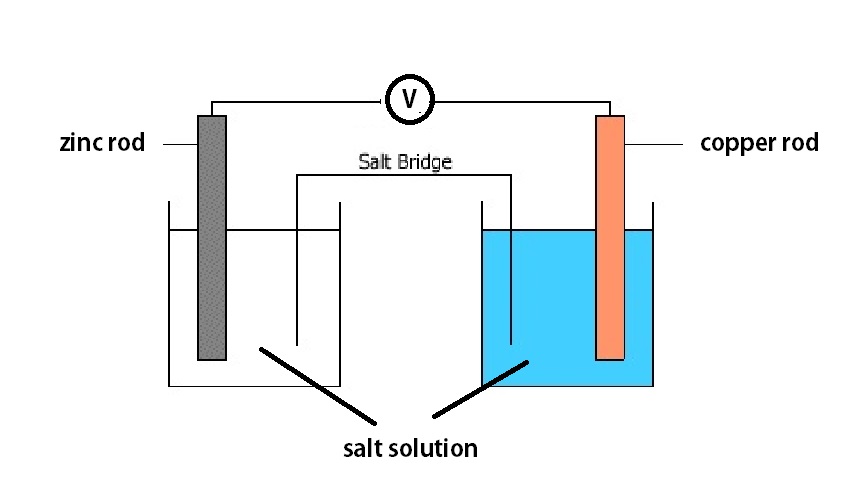
|
• zinc atoms from the zinc rod donate electrons to become Zn2+ ions • the zinc rod is known as the zinc electrode • the zinc rod is the negative terminal of the cell • the electrons travel through the wire to the copper rod • the travelling electrons are a current • Cu2+ ions in the salt solution accept the electrons to become copper atoms • the copper rod is known as the copper electrode • the copper rod is the positive terminal of the cell • the electrons will flow until the Zn atoms or Cu2+ ions are used up • the voltmeter will move to show a potential difference between the electrodes |
| What determines the reactivity of a metal? | metals have a tendency to give always electrons the greater the tendency to give away electrons, the greater the reactivity of the metal |
| What determines the voltage produced in a cell? | the difference in reactivity between the metals the greater the difference in reactivity between the metals, the higher the voltage produced |
| What is a reducing agent? | a substances that causes another substance to be reduced |
| Which metal is reduced in a Daniel Cell? | Cu2+ ions are reduced |
| Which metal is the reducing agent? | Zn is the reducing agent as it causes Cu2+ ions to be reduced |
| What is a primary cell? | a non-rechargeable battery |
| Are the dry cells made with zinc and carbon chargeable or non-rechargeable? | non-rechargeable |
| Are alkaline batteries chargeable or non-rechargeable? | non-rechargeable |
| How does a rechargeable battery work? | the reactions at each electrode is reversed when the battery is connected to a power supply |
| Question | Answer |
|---|---|
| Write the equation for the combustion of hydrogen. | H2 + O2 → H2O |
| What is the benefit of using hydrogen as a fuel? | it burns well and produces no pollutants so could help to reduce the human impact on global warming |
| How does hydrogen as a fuel assist with the problem of global warming? | it does not produce carbon dioxide |
| What are the issues with using hydrogen as a fuel? |
• there are problems with safety and storage of hydrogen for use in a car engine • producing hydrogen by electrolysis uses electricity produced using non-remewable fuels at a power station producing carbon dioxide |
| What is a more efficient use of the electricity from hydrogen to power vehicles than using hydrogen as a fuel? | oxidising hydrogen in a fuel cell |
| What happens in a hydrogen cell? | oxygen and hydrogen react to produce water |
| What makes a hydrogen cell more efficient than using hydrogen as a fuel? | most of the energy released in the reaction is converted to electrical energy |
| What is a use of a hydrogen cell? | hydrogen cells can be used to power a vehicle |
| What is the main disadvantage of a fuel cell? | it needs a constant supply of hydrogen |
| What is the challenge with vehicles powered by hydrogen as a fuel or that use a hydrogen fuel cell? | matching the performance, convenience and price of petrol and diesel vehicles |
| What is the negative terminal of a cell called? | the anode |
| What is the positive terminal of a cell called? | the cathode |
| Which direction do electrons flow? | the anode to the cathode i.e. from negative to positive |
| Which direction does conventional current flow? | the cathode to the anode i.e. from positive to negative |
Below is a simple hydrogen fuel cell. Describe how it works. 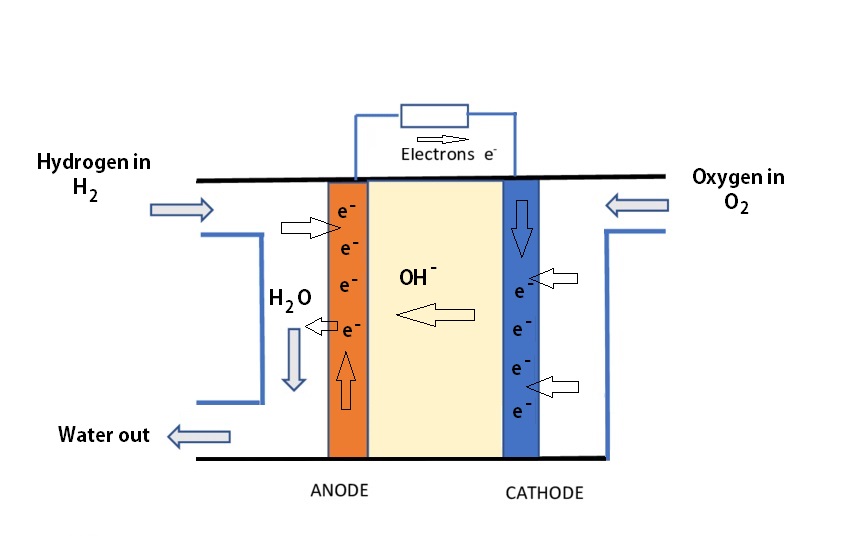
|
• hydrogen gas is supplied to the negative electrode • hydrogen diffuses through the carbon electrode • hydrogen reacts with hydroxide ions to form water • the formation of water provides electrons to an external circuit • water diffuses through the electrode • oxygen gas is supplied to the positive electrode • oxygen diffuses through the carbon electrode • oxygen reacts with water to produce hydroxide ions • the formation of hydroxide ions accepts electrons from an external circuit |
| Write the half equation for the reaction at the anode of a hydrogen fuel cell. | 2H2(g) + 4OH-(aq) → 4H2O(l) + 4e- |
| Write the half equation for the reaction at the cathode of a hydrogen fuel cell. | O2(g) + 2H2O(l) + 4e- → 4OH-(aq) |
| Write the overall equation for the hydrogen fuel cell. | 2H2(g) + O2(g) → 2H2O(l) |
| State the advantages of hydrogen fuel cells. |
• do not need to be electrically recharged • no pollutants produced • can be a range of sizes for different uses |
| State the disadvantages of hydrogen fuel cells. |
• hydrogen is highly flammable • hydrogen is sometimes produced for the cell using non-renewable sources • hydrogen is difficult to store |
A good tutor can build the confidence of a learner enabling subject success
A private tutor can improve the skills a pupil needs to master a subject
Regular tutoring can drive progress and better results in school subjects
Support can help students and parents make the right academic decisions