KS Learning can provide extra lessons for maths from gcse maths tutors in London and help with gcse maths past papers, gcse maths revision notes, and gcse maths revision worksheets. Maths private tuition at its tuition centre can improve maths knowledge and performance through maths lessons, mathematics tutorials and maths tuition Twickenham.
All substances are made of atoms. An atom is the smallest part of an element that can exist. Atoms of each element are represented by a chemical symbol eg Li represents an atom of Lithium and S reprsents an atom of Sulphur. There are about 100 different elements. All the known elements are shown on the periodic table.
The nucleus is at the centre of the atom. It contains protons and neutrons which are together called nucleons.
Around the nucleus are shells which are specific energy levels. Each shell is subdivided into sub-shells, also known as orbitals, and each orbital can house up to two electrons.
Protons, neutrons, and electrons are together referred to as subatomic particles.
The nucleus is actually very, very small. An atom is about 10-10 in size which means that 100 000 000 atoms in a row would be a centimeter long. Atoms of different elements are different sizes but 10-10 cm is a good average.
The nucleus of an atom is about 10-15 m in size; this means that the atom is about 100 000 times the size of the nucleus. The nucleus is actually very, very small. A good comparison of the nucleus to the atom is like a pea in the middle of a racetrack with with first shell at the outside edge of the racetrack, containing a grain of rice, the electron.
The mass of a proton is 1.6726219 × 10⁻²⁷ kilograms. Because this is a very small and inconvenient number, a new unit is defined. The new unit is called the atomic mass unit and is defined as one twelth the mass of a single atom of carbon12. Using this new unit, the proton and the neutron each have a relative mass of 1u (atomic mass unit). The word relative means that this is the mass compared to some sort of reference, in this case carbon12.
An electron is very light compared to the proton and the neutron. A proton is actually 1837 times the mass of an electron. The mass of an electron is negligble which means it is so small that it can generally be ignored. The mass of the protons and atoms combined thus determine the mass of an atom. Although it is very small, the nucleus is massive compared to the rest of the atom.
The charge on an electron is −1.60217662 × 10⁻¹⁹ coulombs. This is also such a small number that it is inconvenient to use, so when referring to atomic particles, everything is compared to the charge on an electron which is defined as −1. Using this relative system, the charge on a proton is + 1 and a neutron is neutral.
Because of the protons, the nucleus is a dense ball of positive charge which exerts an attractive charge on the oppositely charged electrons orbiting the nucleus.
| Particle | Relative Charge | Relative Mass | Symbol |
|---|---|---|---|
| Proton | +1 | 1 | p |
| Neutron | 0 | 1 | n |
| Electron | -1 | negligble | e |
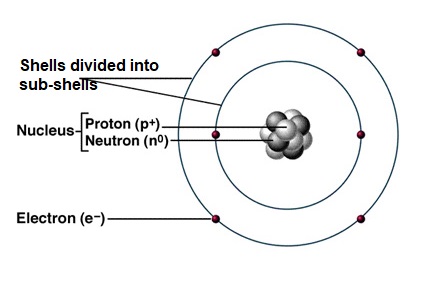
The number of protons in an atom is known as the Atomic Number (Z), and the number of nucleons in an atom is known as the Mass Number (A). Only in a neutral atom, the number of electrons is equal to the number of protons but only in a neutral atom. If the number of electrons is not equal to the number of protons, it is no longer a neutral atom but an ion.
The Atomic Number (Z) and the Mass Number (A) for every element is listed on the periodic table - the mass number is the larger number. For example, 80Br35 means that Bromine has a mass number of 80 and an atomic number of 35. This means that it has 35 protons and 45 neutrons.
Elements are arranged in order of increasing atomic number on the periodic table.
Carbon has 6 protons, and every atom that has 6 protons is called Carbon. If another proton is added, the atom becomes Nitrogen. The number of protons determines the element. The number of electrons can change and the number of neutrons can change but as long as the number of protons does not change, the atom will remain Carbon.
Carbon with 6 neutrons has a total number of 12 nucleons (6 protons and 6 neutrons) and is known as Carbon 12 written as C12. Carbon with 7 neutrons has a total number of 13 nucleons (6 protons and 7 neutrons) and is known as Carbon 13, C13. Carbon with 8 neutrons has a total number of 14 nucleons (6 protons and 8 neutrons) and is known as Carbon 14, C14. All three are referred to as isotopes of Carbon - Carbon because all three have 6 protons and isotopes because the number of neutrons changed.
Most elements occur with multiple isotopes, some have many and some have few. Potassium, for example, has 24 known isotopes from Potassium 32 to Potassium 56. Three isotopes occur naturally, K39, K40, and K41. All three are isotopes of Potassium because all three have 19 protons.
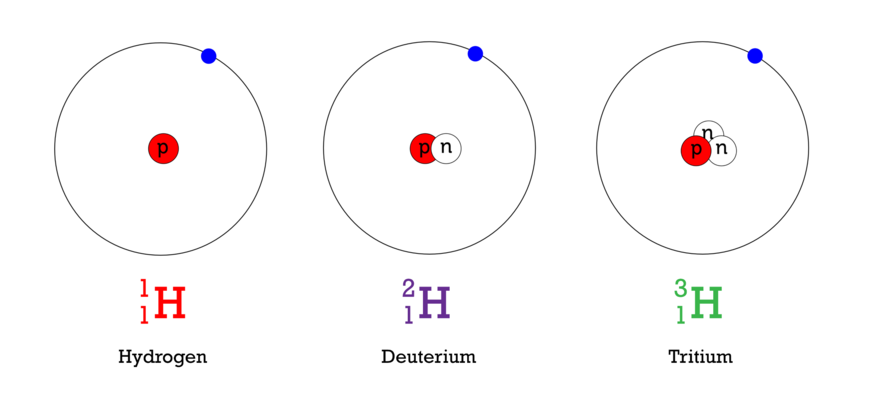
Hydrogen has three common isotopes, one with no neutrons (Hydrogen), one with one neutron (Deuterium), and one with two neutrons (Tritium).
Elements are arranged in order of increasing atomic number on the periodic table. So
Each element (a type of atom) is represented on the periodic table by a symbol which is the same around the world in all languages so while the names of elements may change, chemistry written using the symbols of the periodic table can is the same everywhere. There are around 100 different types of atoms (elements) that occur naturally and every substance on earth is made out of various combinations of these elements.
The columns of the periodic table are known are Groups and the rows of the periodic table are known as Periods. Some of the groups have names -
Atoms can coexist in many different ways, bonded or unbonded.
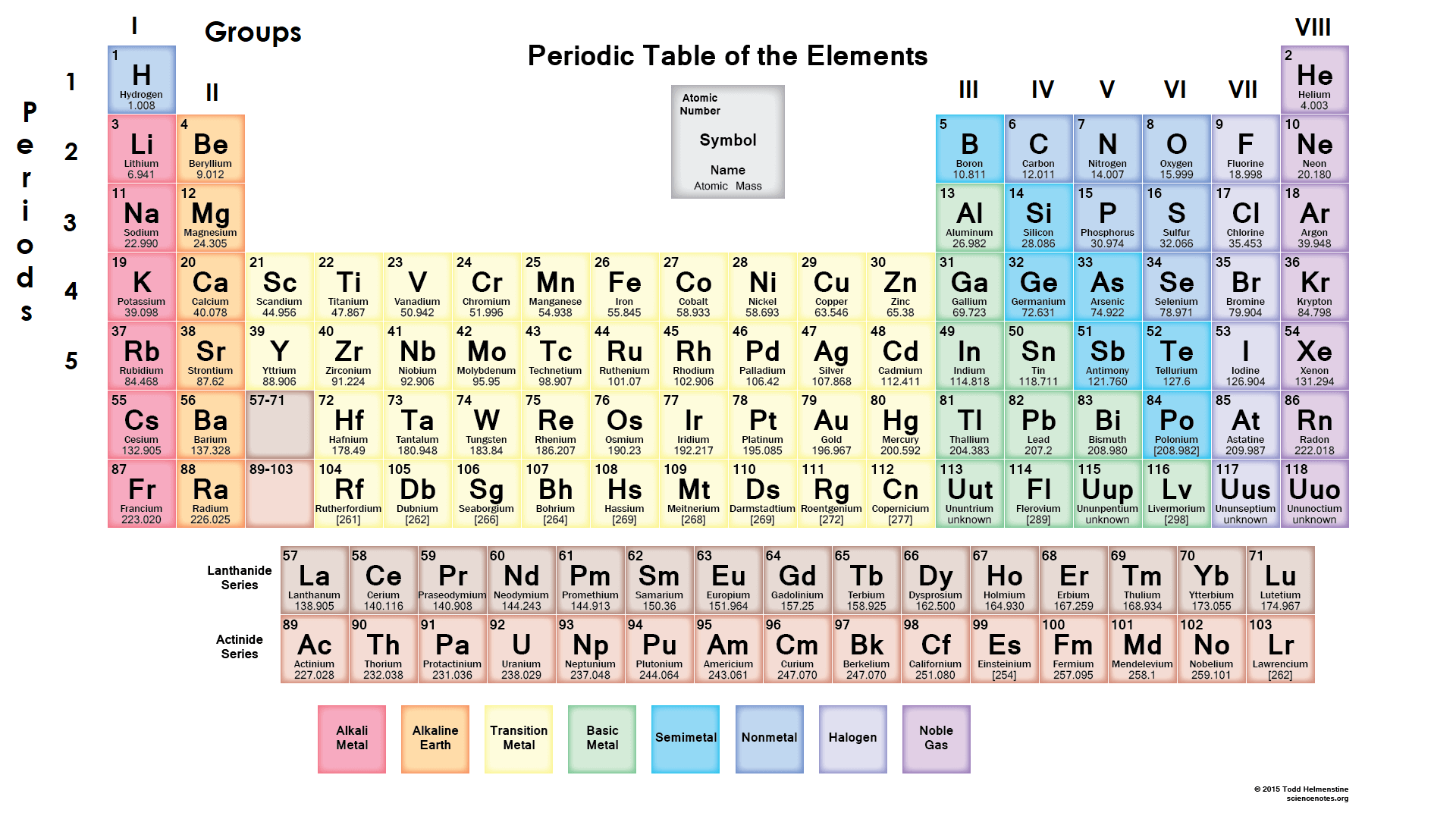
Compounds are formed when two or more elements combine chemically. They always combine in fixed proportions which can be established using the group numbers on the periodic table. The proportions can be worked out using the following bond table.
| Group I | Group II | Group III | Group IV | Group V | Group VI | Group VII |
|---|---|---|---|---|---|---|
| 1 | 2 | 3 | na | 3 | 2 | 1 |
Example 1 - Find the formula for Aluminium Oxide
Example 2 - Find the formula for Magnesium Hydride
Example 3 - Find the formula for Calcium Oxide
The transition elements are not in a group so the table cannot be used. Instead, the chemical name will include the relevant bond number as a Roman numeral.
Example 4 - Find the formula for Copper I Oxide
Example 5 - Find the formula for Copper II Oxide
There are combinations of atoms that operate as a single unit. These are known as covalent ions. Their bond number is the same as their charge.
| Complex Ion | Formula |
|---|---|
| Ammonium | NH41+ |
| Hydroxyl | OH1- |
| Nitrite | NO21- |
| Nitrate | NO31- |
| Sulphite | SO32- |
| Sulphate | SO42- |
| Carbonate | CO22- |
| Phosphate | PO43- |
Chemical reactions involve the formation of one or more new substances as atoms, elements, molecules and/or compounds. Chemical reactions can be represented by word equations.
Example 1
sodium plus chlorine produces sodium chloride
The substances that are put together to react are called the reactants and the substances that result from the reactants are know as the products. The reactants in example 1 are sodium and chlorine and there is only one product, sodium chloride.
Chemical reactions are actually usually represented using symbols and formulae.
Example 2
hydrogen plus oxygen produces water
H2 + O2 → H2O
Diatomic molecules consist of only 2 atoms. In example 2, both hydrogen H2 and oxygen O2 are diatomic. There are 7 elements which always exist as diatomic molecules. The 7 diatomic elements are in the following table -
| Element | Formula |
|---|---|
| hydrogen | H2 |
| nitrogen | N2 |
| oxygen | O2 |
| fluorine | F2 |
| chlorine | Cl2 |
| bromine | Br2 |
| iodine | I2 |
Example 3
nitrogen plus hydrogen produces ammonia
N2 + H2 → NH3
Chemical reactions include state symbols to indicate the form that each chemical takes. The following state symbols are used
Example 4
hydrochloric acid plus magnesium produces magnesium chloride and hydrogen gas
HCl (aq) + Mg (s) → MgCl2 (s) + H2 (g)
Equations also need to be balanced. This means that the number of atoms of each element in the reactants must be the same as the number of atoms of each element of the products.
Example 5
Balance the following equation
N2 + H2 → NH3
Start by considering the first element on the left hand side - N
How many atoms of N are there?
The formula N2 means that there are 2 atoms of N
How many atoms of N are there on the right hand side?
The formula NH3 means that there is 1 atom of N
So there are two atoms of N among the reactants but only 1 in the products.
This cannot be the case as every atom that goes in as a reactant must appear as a product.
To solve this problem, we need to have two molecules of NH3 making the equation
N2 + H2 → 2NH3
This solves the problem with atoms of N but creates another problem.
Consider the atoms of H on each side of the equation.
On the left hand side there are 2 atoms of H because of H2.
On the right, there are 3 atoms of H in NH3 and because we have now doubled the NH3 there are actually 6 atoms of H
To fix this problem with need to treble the number of H2 molecules.
The equation then looks like this
N2 + 3H2 → 2NH3
There a now an equal number of atoms of each element on each side of the equation, and we say that the equation is balanced.
Exercise A - write the following equations in symbols and balance them
Exercise B - balance the following equations
An ion is an atom or molecule with a charge by gaining or losing electrons. When sodium chloride NaCl dissolves in water, it separates into two ions, a positive sodium ion Na+ and a negative chlorine ion Cl-. Molecules that are made of ions are known as ionic compounds.
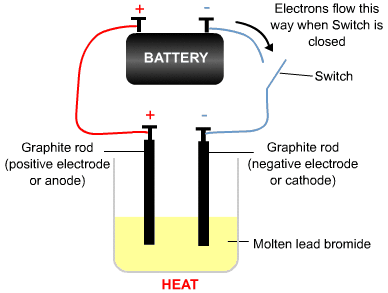
Lead (II) Bromide PbBr2 is an ionic compound. Lead (II) Bromide contains positively charged lead ions Pb2+ and negatively charged bromide ions Br-. When PbBr2 is heated to over 373 °C, it melts and breaks into these ions.
Electrolysis breaks ionic compounds into simpler substances by passing a direct electric current through the ionic compound. The compound has to either be molten or dissolved as the ions must be able to move for electrolysis to work. For example, molten PbBr2 can be separated into the metal lead Pb and the gas Bromine Br2 using electrolysis.
In the case of Lead (II) Bromide, a graphite electrode is connected to the positive pole of a battery and placed in the molten liquid - it is referred to as the positive electrode or the cathode. A graphite electrode is also connected to the negative pole of the same battery and placed in the molten liquid - it is referred to as the negative electrode or the anode. The positively charged lead ions Pb2+ move to the negative electrode where they receive electrons and become the metal lead Pb - gaining electrons as lead Pb does in this reaction is known as reduction. The negatively charged bromine ions move to the positive electrode where they lose electrons and combine to form the gas Bromine Br2 - losing electrons as Bromine does in this equation is known as oxidation. The process of using electricity to convert PbBr2 into solid Lead and Bromine gas is known as electrolysis and the substance that is broken down is called the electrolyte.
Electolysis is an important process in the production and purification of metals like Copper. Electrodes of metal, graphite and semiconductor material are widely used. Choice of suitable electrode depends on chemical reactivity between the electrode and electrolyte and manufacturing cost.
A good tutor can build the confidence of a learner enabling subject success
A private tutor can improve the skills a pupil needs to master a subject
Regular tutoring can drive progress and better results in school subjects
Support can help students and parents make the right academic decisions