KS Learning can provide extra lessons for maths from gcse maths tutors in London and help with gcse maths past papers, gcse maths revision notes, and gcse maths revision worksheets. Maths private tuition at its tuition centre can improve maths knowledge and performance through maths lessons, mathematics tutorials and maths tuition Twickenham.
| Question | Answer |
|---|---|
| Compare a scalar and a vector. | a scalar has magnitude (size) only, and a vector has magnitude and direction |
| What is distance? | the length of the actual path followed with all its twists and turns |
| What is displacement? | displacement is distance in a given direction i.e. distance without a change in direction is displacement |
| List 5 scalars | speed, distance, time, mass, energy, and power |
| List 5 vectors | displacement, velocity, acceleration, force, momentum, weight, and gravitational field strength |
| How is a vector represented? |
• as an arrow • the direction of the arrow represents the direction of the vector • the length of the arrow represents the magnitude of the vector |
| How are multiple forces on an object shown? |
on a force diagram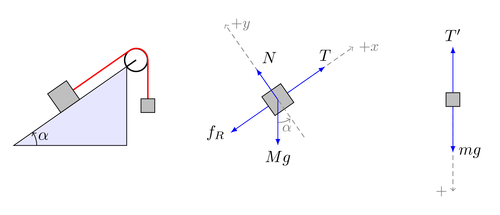 |
| How is the length of the arrow decided? | using a scale so that the arrow can be drawn at a sensible size |
| A force is represented by an arrow that is 5cm long using a scale of 1mm to 1 N. | 5cm = 50mm so the force is 50N |
| Question | Answer |
|---|---|
| What is a force? | it is a push or a pull that acts on an object |
| What are possible effects when a force is applied to an object? | change the shape of an object, or change the state of rest or its motion |
| What is a contact force? | when two objects must touch for a force to act, it is a contact force |
| Name three contact forces. | friction, air resistance, tension |
| What is a non-contact force? | when contact is not required for a force to act |
| Name three non-contact forces. | magnetic force, electromagnetic force, the force of gravity |
| What is the unit of force? | Newtons (N) |
| State Newton's third law. | For every force, there is another force that is equal in magnitude and opposite in direction |
| Explain Newton's third law. | It means that in every interaction, there is a pair of forces acting on the two interacting objects, and that the size of the force on the first object equals the size of the force on the second object. The direction of the force on the first object is opposite to the direction of the force on the second object |
| A tractor pulls a car attached to it by a rope. What is the force in the rope? | tension |
| What does Newton's 3rd Law say about the forces on the car where it is connected to the tow rope? | the car pulls on the rope and the rope pulls on the car with a force of the same magnitude in the opposite direction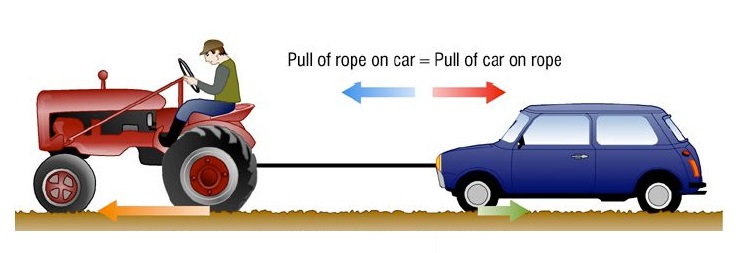 |
| What is the force called that makes a car move? | the driving force |
| What enables the driving force to push the car forward? | friction between each tyre and the ground |
| What forces act where the tyre meets the ground? |
• the force of the friction on the road • the force of the friction on the tyre • the two forces are equal in magnitude but opposite in direction |
| Question | Answer |
|---|---|
| What is the resultant force? | it is the single force that has the same impact on an object as all the forces acting on the object |
| What is meant by saying that the forces on an object are balanced? | the resultant force on an object is zero |
| State Newton's frst law | if the sum of the forces on an object is zero, the object will remain at rest or continue at a constant velocity |
| What is the term for an object not moving? | stationary |
| Describe the two forces on an object with a resultant of zero. | the forces are of equal magnitude and act in opposite directions |
| Describe the motion of a glider moving on a linear air track. | there are no forces acting on the object so the glider will continue to move in the same direction at the same speed according to Newton's first law |
| Describe the forces when a crate is pushed across a rough floor at a constant speed by a person. | the force provided by the person which is equal in magnitude to the force of frition by the floor on the crate, and in opposite directions according to Newton's first law |
| What is meant by saying that the forces on an object are unbalanced? | the resultant force on an object is NOT zero |
| What determines the motion of an object when the forces on an object are not balanced? | the size and direction of the resultant force |
| What are the forces on a jet plane taking off? |
• the thrust force of the engines • the air resistance known as drag on the jet plane |
| What is the resulant force on a jet plane taking off? | the difference between the thrust force of the engines and the air resistance on the plane |
| Are the forces on a jet plane balanced? | no, the thrust forces must be greater than the air resitance or the plane would remain stationary on the ground |
| Describe the resulant force when an object is acted upon by two unequal forces acting in opposite directions. | the resultant force is • equal to the dfference between the two forces • in the direction of the larger force |
| What is the impact on motion when the reultant force on an object is (a) zero (b) greater than zero |
(a) the object stays at rest or moves at a constant velocity (b) the spped of the object will increase or direction of the object will change |
| A tractor pulls a car that is stuck in the mud but the car does not move. Why? | the force applied by the tractor to the car is of equal magnitude and in the opposite direction to friction of the mud so it will remain at rest as Newton's first law states |
| Describe the forces in a tug of war when despite pulling their hardest, neither team moves. | because their is no motion the pull forces from the teams must be of equal magnitude and in opposite direction i.e. the pull forces are balanced |
| What is a free-body force diagram? | a diagram that shows the forces acting on an object |
| Question | Answer |
|---|---|
| x | x |
| x | x |
| Question | Answer |
|---|---|
| x | x |
| x | x |
| Question | Answer |
|---|---|
| x | x |
| x | x |
| Question | Answer |
|---|---|
| x | x |
| x | x |
| Question | Answer |
|---|---|
| x | x |
| x | x |
| Question | Answer |
|---|---|
| x | x |
| x | x |
A good tutor can build the confidence of a learner enabling subject success
A private tutor can improve the skills a pupil needs to master a subject
Regular tutoring can drive progress and better results in school subjects
Support can help students and parents make the right academic decisions