
KS Learning can provide extra lessons for maths from gcse maths tutors in London and help with gcse maths past papers, gcse maths revision notes, and gcse maths revision worksheets. Maths private tuition at its tuition centre can improve maths knowledge and performance through maths lessons, mathematics tutorials and maths tuition Twickenham.
| Question | Answer |
|---|---|
| State the word equation for constant speed. |
\( \text {speed} = \frac{\text {distance travelled}}{\text {time taken}} \) |
| Write the symbol equation for constant speed. |
\( \text {v} = \frac{\text {s}}{\text {t}} \) |
| State the units of - (a) speed (b) distance (c) time |
the units of - (a) speed are metres per second (m/s) (b) distance are metres (m) (c) time are seconds (s) |
| Sketch a distance-time graph for an object that is - (a) stationary (b) moving at a constant speed (c) accelerating |
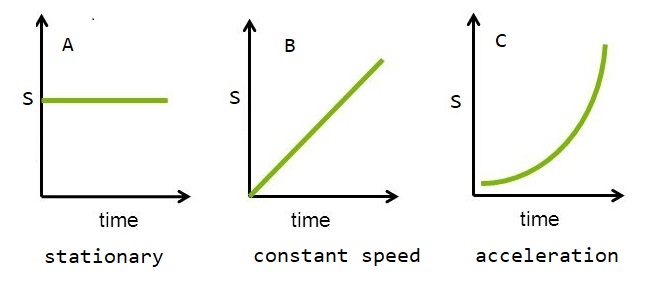 |
| What does the gradient of a distance-time graph represent? | it represents speed |
| What is a tacograph? | equipment fitted to a vehicle that records its speed and distance |
Describe the journey that produces the graph below -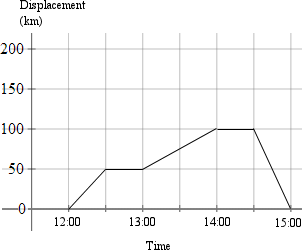 |
12:00 to 12:30 - vehicle travels 50m at a constant speed 12:30 to 13:00 - vehicle is stationary 13:00 to 14:30 - vehicle travels a further 50m at a constant speed 14:00 to 14:30 - vehicle is stationary 14:30 to 15:00 - vehicle travels back to where it started |
| A train takes 1 hour and 15 minutes to travel 180km. Find the speed of the train. |
First convert to standard units. time = 1 hour and 15 minutes = 75 minutes = 4500 seconds distance = 180km = 180 000 metres
\( \text {speed} = \frac{\text {distance travelled}}{\text {time taken}} \) |
| Question | Answer |
|---|---|
| What is a vector and a scalar? | a vector has both direction and magnitude but a scalar only has magnitude |
| What is the difference between speed and velocity? | speed is a scalar and velocity is a vector |
| What is velocity? | speed in a given direction |
| Describe a situation with bodies that have the same speed but different velocity. | two cars are both travelling at 30 m/s with one going south and one going north have different velocities because they are travelling in opposite directions |
| Describe a situation where a body has a constant speed but not a constant velocity | an object travelling in a circle with a constant speed will not have a constant velocity because its direction keeps changing |
| What is displacment? | a distance and a direction |
| Describe the motion of an object moving with a constant velocity. | it is moving with a constant speed without changing direction i.e. moving in a straight line |
| What is acceleration? | the change of velocity per second |
| What are the units of acceleration? | metres per second squared (m/s2) |
| State the word equation for average acceleration. |
\( \text {acceleration} = \frac{\text {change in velocity}}{\text {time taken for the change}} \) |
| Write the symbol equation for average acceleration. |
\( \text {a} = \frac{\text {Δv}}{\text {t}} \) |
| How does one find acceleration from a velocity-time graph? | the gradient |
State the symbol and units for • acceleration • initial velocity • final velocity • time taken |
The symbol and unit for • acceleration is a and m/s2 • initial velocity is u and m/s • final velocity is v and m/s • time taken is t and s |
| What is the formula for acceleration? |
\( \text {a} = \frac{\text {v - u}}{\text {t}} \) |
| What is the effect of deceleration? | it slows an object down |
| What is another name for deceleration? | negative acceleration |
| Question | Answer |
|---|---|
| Describe what acceleration measures? | how veolcity changes |
| What equipment can be used to monitor the motion of a moving trolley? | a motion sensor connected to a computer |
| What happens to the velocity of a trolley as it rolls down a runway? | the velocity increases i.e. it accelerates |
| What happens if the runway is made steeper? | the velocity increases faster i.e. acceleration is greater |
| What does a straight line graph of velocity against time say about acceleration? | it says acceleration is constant |
| Sketch 9 separate graphs • an s-t, v-t and a-t graph for a stationary body • an s-t, v-t and a-t graph for a body moving with a constant velocity • an s-t, v-t and a-t graph for a body moving with constant acceleration |
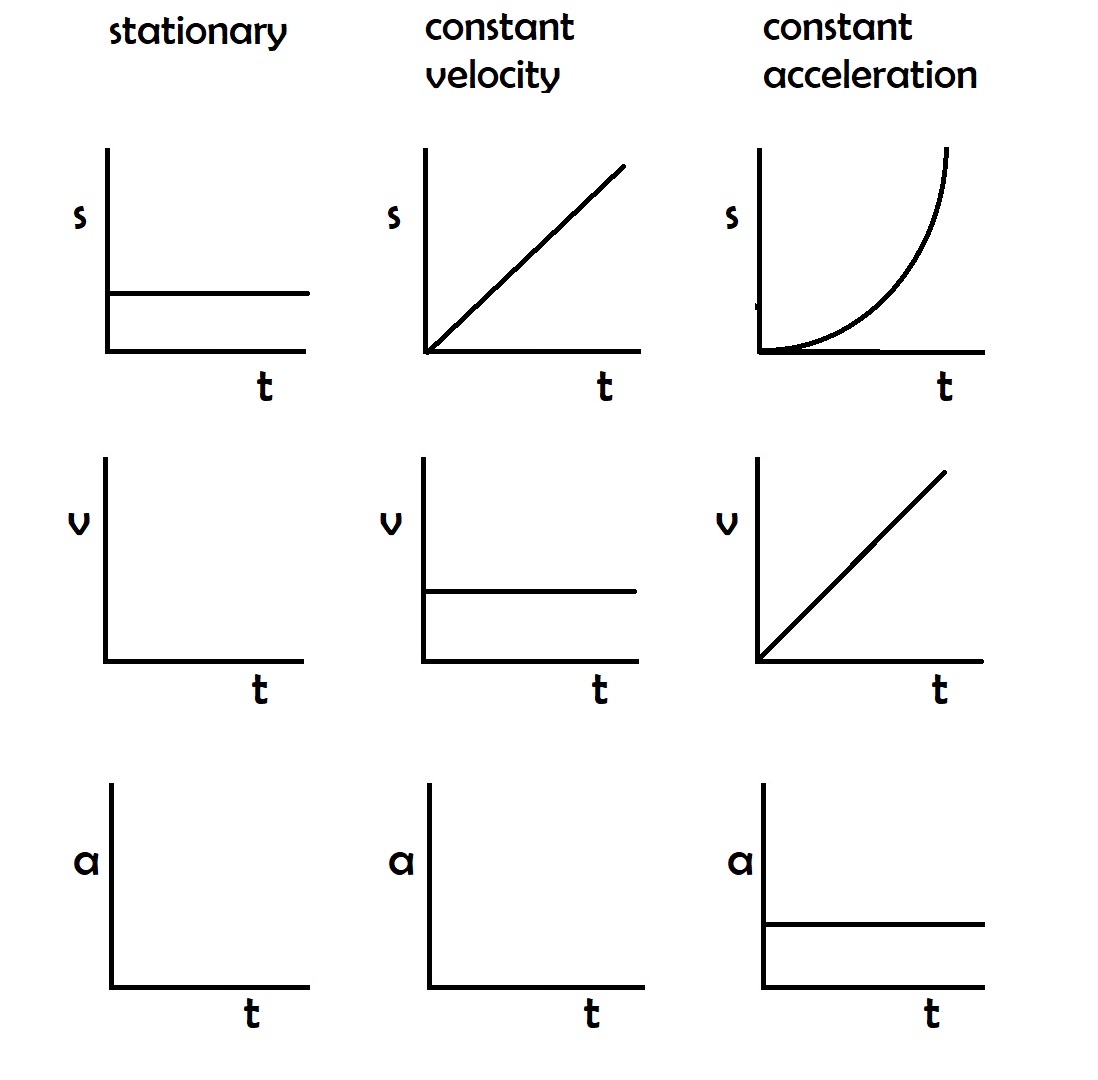 |
| How do you find velocity from an s-t graph? | the gradient |
| How do you find the acceleration from a v-t graph? | the gradient |
| How do you find the distance travelled from a v-t graph? | the area under the graph |
| What is the effect of braking on a moving vehicle? | it slows the vehicle down |
| What is the acceleration of a vehicle moving at a constant velocity? | zero |
| What does a positive gradient on a v-t graph represent? | a positive acceleration i.e. the velocity is increasing |
| What does a negative gradient on a v-t graph represent? | a negative acceleration i.e. the velocity is decreasing, sometimes known as deceleration |
| Question | Answer |
|---|---|
| Describe the distance-time graph of an object moving at a constant speed. | a straight line sloping upwards |
| What is the gradient of a distance-time graph represent? | the speed of an object |
| How is the gradient of a graph found when it is not a straight line? | by drawing a tangent to the point where the speed is wanted, and finding the gradient of the tangent |
| Describe the speed-time graph of an object moving at a constant acceleration. | a straight line sloping upwards |
| What is the gradient of a speed-time graph represent? | the acceleration of an object |
| What is the word equation for average acceleration? |
\( \text {average acceleration} = \frac{\text {change of velocity}}{\text {time taken}} \) |
| How is the distance travelled found from a speed-time graph? | the area under the line of a speed-time graph is the distance |
| State the three equation for a body moving at a constant acceleration. |
• v = u + at • s = ut + 1/2 at2 • v2= u2 + 2as |
A good tutor can build the confidence of a learner enabling subject success
A private tutor can improve the skills a pupil needs to master a subject
Regular tutoring can drive progress and better results in school subjects
Support can help students and parents make the right academic decisions