KS Learning can provide extra lessons for maths from gcse maths tutors in London and help with gcse maths past papers, gcse maths revision notes, and gcse maths revision worksheets. Maths private tuition at its tuition centre can improve maths knowledge and performance through maths lessons, mathematics tutorials and maths tuition Twickenham.
| Question | Answer |
|---|---|
| What are all substances made of? | small particles called atoms |
| How many types of atoms are there? | there are around 100 different types of atoms found naturally on earth |
| How many substances can be created? | there are an unlimited number of combinations of atoms and hence substances |
| What is an element? | an element is a substance made up of only one type of atom i.e. all the atoms have the same number of protons |
| How many different elements are there? | there are around 100 different types of atoms found naturally on earth and thus 100 different elements |
| How are elements represented in chemistry? | as symbols |
| Why are elements represented by symbols in chemistry? |
• the symbols are universal so they can be understood by everyone around the world regardless of language • the names of elements are different in each language but the symbols remain the same |
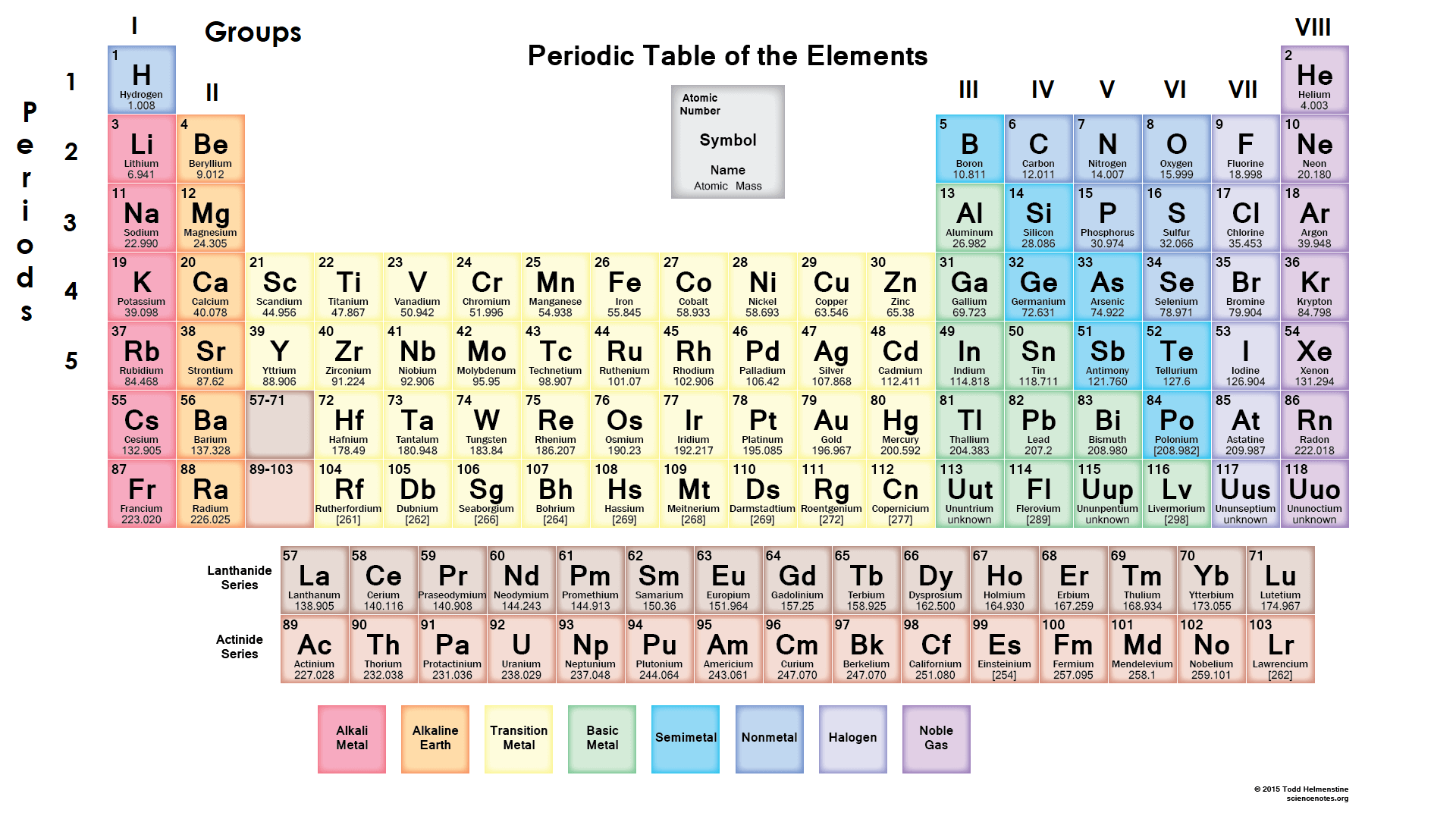
| Where can a complete list of elements be found? | on the periodic table |
| What are the columns on the periodic table called? | groups |
| What are the rows on the periodic table called? | periods |
| How many elements are there in the first period? | two |
| Name the elements in the first period. | hydrogen and helium |
| What is the name of group I? | the alkali metals |
| What is the name of group II? | the alkaline earth metals |
| What is the name of group VII? | the halogens |
| What is the name of group VIII? | the noble gases |
| What are the elements between group 2 and 3 called? | the transition metals |
| Where are the transition metals? | between group 2 and group 3 |
| Where are metals and non-metals found on the periodic table? | metals are on the left and non-metals are on the right separated by the semi-metals |
| How does the number of metals compare to the number of non-metals? | there are a lot more metals than non-metals |
| What does the 'staircase' on the periodic table represent? | it is the semi-metals, also known as metalloids because they have some metallic and some non-metallic properties |
| Why are the elements on the 'staircase' of the periodic table called semi-metals? | because they have some metallic and some non-metallic properties |
| What is a molecule? | two or more atoms chemically bonded |
| What is a compound? | two or more elements chemically bonded |
| Describe the basic structure of an atom | it has a nucleus at its centre with protons and neutrons in it, and shells with orbitals around the nucleus where electrons are found |
| What information can be deduced from the formula CO2? | • it contains one atom of carbon • it contains two atoms of oxygen • it is a molecule because it contains two or more atoms chemically combined • it is also a compound because it contains two or more elements chemically combined |
| What information can be deduced from the formula O3? | • it contains three atoms of oxygen • it is a molecule because it contains two or more atoms chemically combined • it is also an element because it contains only one type of atom |
| Question | Answer |
|---|---|
| What does a chemical reaction show? | the substances you start with and the new substances that are made from them |
| What are the reactants? | the substances you start with in a reaction |
| What are the products? | the new substances made from the reactions in a reaction |
| How is a reaction written? | reactants → products |
| Write the word equation for the test of hydrogen gas? | hydrogen + oxygen → water |
| Name the reactants in the test for hydrogen gas? | hydrogen and oxygen |
| Name the products in the test for hydrogen gas? | water |
| Write the word equation for the heating of calcium carbonate. | calcium carbonate → calcium oxide + carbon dioxide |
| Write the symbol equation for the heating of calcium carbonate. | CaCO3 → CaO + CO2 |
| What does it mean to describe a reaction as balanced? | there are the same number of atoms of each element on each side of the reaction |
| State the law of conservation of mass. | the total mass of the products formed is equal to the total mass of reactants |
| When calcium carbonate is heated, it appears to lose mass. Has the law of conservation of mass been broken? | no, it appears to have lost mass because carbon dioxide has escaped into the air |
| When copper is heated in air, it appears to gain mass. Has the law of conservation of mass been broken? | no, it appears to gain mass because the copper reacts with oxygen in the air to form copper oxide |
| How does the mass of products compare to the mass of reactants? | the mass of products and the mass of reactants remain the same because of the law of conservation of mass |
| What is a precipitate? | a solid formed in the reaction between two solutions |
| List the state symbols used in reactions. | (s) for solids, (l) for liquids, (g) for gases, and (aq) for substances dissolved in water |
| Write the symbol equation for the heating of calcium carbonate inluding state symbols. | CaCO3(s) → CaO(s) + CO2(g) |
|
Balance the following equation N2 + H2 → NH3 Start by considering the first element on the left hand side - N How many atoms of N are there? The formula N2 means that there are 2 atoms of N How many atoms of N are there on the right hand side? The formula NH3 means that there is 1 atom of N So there are two atoms of N among the reactants but only 1 in the products. This cannot be the case as every atom that goes in as a reactant must appear as a product. |
To solve this problem, we need to have two molecules of NH3 making the equation N2 + H2 → 2NH3 This solves the problem with atoms of N but creates another problem. |
|
Consider the atoms of H on each side of the equation. On the left hand side there are 2 atoms of H because of H2. On the right, there are 3 atoms of H in NH3 and because we have now doubled the NH3 there are actually 6 atoms of H |
To fix this problem we need to treble the number of H2 molecules. The equation then looks like this N2 + 3H2 → 2NH3 There a now an equal number of atoms of each element on each side of the equation, and we say that the equation is balanced. |
| Balance H2 + O2 → H2O | 2H2 + O2 → 2H2O A full explanation of how to balance an equation can be found in example 5 of chemistry notes |
Exercise A - write the following equations in symbols and balance
Exercise B - balance the following equations
| Question | Answer |
|---|---|
| What is a mixture? | a mixture is made up of two or more substances that are not chemically combined |
| State the properties of compounds | • compounds have a fixed composition • there are chemical bonds between the atoms of a compound • chemical reactions are needed to separate the elements in a compound |
| State the properties of mixtures | • mixtures have no fixed composition • there are no chemical bonds between the substances in a mixture • mixtures can be separated by physical means |
| Explain what is meant by compounds have a fixed composition. | the ratio of elements present is always the same so for example every molecule of carbon dioxide is always made of a single atom of carbon and two atoms of oxygen |
| List the physical methods of separating mixtures |
• filtration • crystallisation • distillation • chromatography |
| What do methods of separating mixtures rely on to work? | the differences of the physical properties of each substance in the mixture |
| When is filtration used? | when one substance is soluble in a particular solvent and one is not |
| Give an example of a mixture that can be separated by filtration | a mixture of salt and sand can be separated by filtration |
| How can salt and sand be separated by filtration? |
• add water to the mixture • pour onto filter paper • wash the sand on filter paper with distilled water • dry the wet sand in a warm oven |
| What is the residue? | the substance that is left on the filter paper |
| What is the filtrate? | the dissolved substance in the solvent that passes through the filter paper |
| What is the chemical name and formula for table salt? | sodium chloride, NaCl |
| Name a technique used to separate salt dissolved in water. | crystallisation |
| How does crystallisation separate salt and water in a solution? | by evaporating the water |
| What is the best way of evaporating water from a solution of salt and water? | heating the solution in an evaporating dish on a water bath |
| Why is using an evaporting dish on a water bath better than direct heating on a tripod and gauze? | because it is gentler |
| How long should the water solution be heated? | when the solution is at the point of crystallisation |
| How can one tell that a solution being heated is at the point of crystallisation? |
• small crystals first appear around the edge of the solution, OR • crystals appear in a drop of solution extracted from the dish with a glass rod |
| What is done to extract the salt from the solution when it has reached the point of crystallisation? | the solution is left at room temperature for the water to evaporate off and crystals to form |
| What containers would be suitable for the solution at room temperature? | a flat-bottomed crystallisation dish or Petri dish |
| Why are a flat-bottomed crystallisation dish or Petri dish suitable for evaporating the remaining water off the solution? | they provide a large surface area for the water to evaporate from |
| When is crystallisation used? | to separate a soluble solid from a solvent |
| What technique is used to collect a liquid from a solution? | distillation |
| Describe a practical example of distillation? | producing fresh drinking water from sea water |
| Describe the process of distillation. |
• heat the solution to boiling • pass the vapour coming off the boiling liquid through a condenser • the vapour cools and becomes a liquid • collect the liquid in a receiving vesssel |
| What is a condenser? | an outer glass tube with water flowing through it that cools an inner glass tube |
| Question | Answer |
|---|---|
| What are miscible liquids? | liquids that dissolve in each other mixing completely like squash and water |
| What are immiscible liquids? | liquids that do not dissolve in each other and will form layers if left to stand like oil and water |
| What technique is used to separate multiple miscible liquids mixed together? | fractional distillation |
| How does fractional distillation work? | The liquid is heated until it is complete vapourised The vapour enters the fractionating column at the base The vapour moves up the fractionating column cooling as it goes The vapour is at its hottest at the bottom of the column As the vapour cools, a fraction condenses and is drained off |
| Why is it difficult to get pure liquids by simple distillation? | because vapour is given off by each liquid before it reaches its boiling point |
| How can the separation of liquids be improved with simple distillation? | add a fractionating column containing glass beads |
| What is a fractionating column? | a tall glass column filled with beads |
| How does a fractionating column work? |
• the vapours pass over the glass beads as they rise towards the condenser • the temperature in the fractionating column is at its highest at the bottom, getting lower going up the column • the vapours with the highest boiling point will condense more readily at the bottom of the column and drip back into the flask • the substances with the lowest boiling point will rise and enter the condenser • the vapours in the condenser will turn back into the liquid state |
| When a mixture of ethanol (bp 78 °C) and water (bp 100 °C) are separated by distillation, which substance passes through the condenser? | ethanol |
| What is the test for ethanol? | the liquid will ignite |
| Name two examples where fractional distillation is used to separate ethanol. |
• from a fermented mixture in the alcoholic spirits industry • from a fermented mixture in the biofuel industry |
| Name a technique that is used to separate and identify substances from mixtures in solution. | paper chromatography |
| What is paper chromatography? | a technique used to separate mixtures of substances dissolved in a solute |
| Why does paper chromatography work? | because some compounds in a mixture will dissolve better in the solvent chosen i.e. due to different solubilities |
| What happens in paper chromatography? | different substances separate as they move up the chromatography paper at different speeds |
| Describe the procedure using paper chromatography? |
• a spot of the solution is dabbed on the bottom of absorbant chromatography paper using a capillary tube • the chromatography paper is placed standing up in a beaker of solvent • the solvent soaks up the paper running through the spot of the solution • different substances in the mixture move up the paper for different distances |
| Question | Answer |
|---|---|
| Name the people in chronological order that contributed to the modern understanding of the atom. |
• John Dalton • JJ Thompson • Ernst Rutherford • Niels Bohr • James Chadwick |
| What did Dalton propose? |
• substances are made up of atoms which are like tiny, hard spheres • each element has its own atoms with their own unique mass • atoms cannot be divided or split |
| What did JJ Thompson discover? | he discovered the electron, a negatively charged particle about 2000 times lighter than the smallest atom |
| What did JJ Thompson overturn in Dalton's ideas? | he showed that the atom could be split |
| How did Thompson describe the atom? | a cloud of positive charge that contains tiny negatively charged electrons like the fruit in a plum pudding |
| How did Thompson deduce his model? | because the atom had no charge and electrons had a negative charge, he deduced that the rest of the atom must be positive |
| What experiment did Geiger and Marsden conduct? | they fired dense, positively charged particles (called alpha particles) at thin gold foil monitoring where the alpha particles went |
| What were the outcomes of the Geiger and Marsden experiment? |
• most of the particles passed straight through the gold foil without any change of direction • some of the particles were deflected off course as they passed through the gold foil • a very small number of particles bounced back off the gold foil |
| What did Rutherford conclude from the evidence collected by Geiger and Marsden? |
• there is a small, dense positive nucleus at the centre of the atom • electrons orbit around the nucleus • most of the atom is empty space • the nucleus contains dense, positively charged particles named protons |
| What did Niels Bohr notice? | light given out by atoms when heated only had specific energies |
| What did Niels Bohr deduce? | electrons orbit the nucleus at fixed distances in set energy levels called shells |
| Why was the neutron proposed? | the mass of the atom did not match the number of protons - some mass was missing |
| What properties did the neutron have to have? |
• no charge - neutral • the same mass as a proton |
| What did James Chadwick achieve? | he proved the existence of the neutron |
| Question | Answer |
|---|---|
| Name the sub-atomic particles in the atom. | protons, neutrons, and electrons |
| Describe the structure of the atom. | a tiny nucleus in the centre that contains neutrons and protons with electrons orbting around the nucleus |
| State the relative charge of each sub-atomic particle |
• proton +1 • neutron neutral • electron -1 |
| State the relative mass of each sub-atomic particle |
• proton 1 • neutron 1 • electron negligble |
| What is the overall charge of the nucleus? | positive |
| What is the overall charge of the atom? | neutral |
| Where is mass concentrated in the atom? | in the nucleus - the mass of electrons is negligble |
| What does the fact that the overall atom is neutral, say about charges in the atom? | the negative and positive charges are equal so the number of protons is the same as the number of electrons |
| If a carbon atom has 6 protons, how many electrons must it have? | 6 electrons |
| What is the atomic number of an element? | the number of protons in the nucleus of each atom of the element |
| What is the mass number of an element? | the number of protons and neutrons in the nucleus of an element |
| What is the relationship between the number of electrons and the atomic number? | in a neutral atom they are equal |
| How can the number of neutrons be calculated? | mass number - atomic number |
| Question | Answer |
|---|---|
| What is an ion? | an atom with a charge because it has gained or lost an electron |
| What types of ions exist? |
• positive ions • negative ions |
| How is a positive ion formed from a neutral atom? | the atom loses one or more electons |
| How is a negative ion formed from a neutral atom? | the atom gains one or more electons |
| What is the charge on an atom when it gains two electrons? | -2 |
| What is the charge on an atom when it loses three electrons? | +3 |
| What can you deduce about electrons from X-3? | the neutral atom has gained 3 electrons |
| Name the two numbers next to each symbol on the periodic table. |
• atomic number • mass number |
| State the symbol for each of the two numbers next to each symbol on the periodic table. |
• atomic number Z • mass number A |
| Given Na has an atomic number of 11 and a mass number of 23, how many protons, electrons, and neutrons are there in a neutral atom. |
•11 protons •11 electrons •12 neutrons (23 - 11) |
| What is the average number of atoms in a person? | 7 000 000 000 000 000 000 000 000 000 atoms, that is, 7 with 27 zeros (7 octillion) |
| What is the average size of an atom? | a tenth of a billionth of a metre |
| What do all the atoms in an element have in common? | atoms of the same element always have the same number of protons |
| What makes an atom into a carbon atom? | the fact that the atom has 6 protons |
| Name the element which is made of atoms with 11 protons. | sodium Na |
| What are isotopes? | atoms of the same element with different numbers of neutrons |
| What remains the same with different isotopes of an element? | chemical properties |
| What changes with different isotopes of an element? | physical properties such as density |
| Compare the subatomic particles of 13C and 12C. |
• carbon-13 has 7 neutrons and carbon-12 has 6 neutrons • carbon-13 and carbon-12 both have 6 protons • carbon-13 and carbon-12 both have 6 electrons |
| What happens to carbon-12 when a proton is added? | it becomes nitrogen-13 |
| What happens to carbon-12 when a neutron is added? | it remains carbon but changes some of the physical properties |
| How do the electrons of a neutral atoms of the same element compare? | they have the same number of electrons |
| What can happen as the number of neutrons are increased? | the nucleus can become unstable |
| How does the electronic structure of different isotopes of an element compare? | the electronic structure of all atoms of the same element is identical |
| Name the three isotopes of Hydrogen. |
• hydrogen-1 known as hydrogen • hydrogen-2 known as deuterium • hydrogen-3 known as tritium |
| Compare the three isotopes of hydrogen. |
• they all have the same chemical properties • they all have different masses • tritium is radioactive |
| Question | Answer |
|---|---|
| Where are electrons in the atom? | they are arranged around the nucleus in shells |
| What do shells represent? | different energy levels |
| Which is the lowest energy level? | the one closest to the nucleus |
| How do electrons fill the energy levels? | each electron occupies the lowest empty energy level |
| State the maximum number of electrons by energy level. |
• the first energy level can hold up to 2 electrons • the second energy level can hold up to 8 electrons • the third energy levels takes 8 electrons before the fourth energy level begins to fill |
| Draw the energy levels for a sodium atom (atomic number 11). | 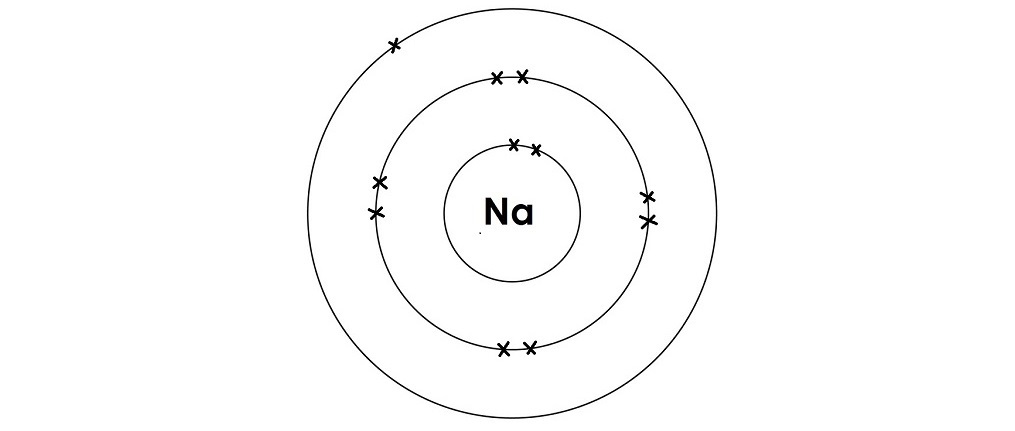 |
| Write the electronic structure for a sodium atom (atomic number 11). | 2, 8, 1 |
| How many electrons are there in the outer shell of group I elements? | 1 |
| How many electrons ae there in the outer shell of group II elements? | 2 |
| What is the relationship between the number of electrons in the outer shell and the group number on the periodic table? |
• Group I has 1 electron • Group II has 2 electrons • Group III has 3 electrons • Group IV has 4 electrons • Group V has 5 electrons • Group VI has 6 electrons • Group VII has 7 electrons |
| What determines the way an element reacts? | the number of electrons in its outer shell |
| Why do elements in a group react in a similar way? | because they have the same number of electrons in the outer shell |
| What is the name of Group 0? | noble gases |
| How reactive are the noble gases? | highly unreactive |
| Why are noble gases highly unreactive? | all of them have a very stable arrangement of electrons with 8 electrons in the outer shell except Helium which has 2 electrons |
A good tutor can build the confidence of a learner enabling subject success
A private tutor can improve the skills a pupil needs to master a subject
Regular tutoring can drive progress and better results in school subjects
Support can help students and parents make the right academic decisions